Between dog and wolf

Between dog and wolf the light forgets its name—
a violet seam where breath hangs like a question.
Leaves hold their colours like old promises,
and shadows lengthen, trying on nearer ghosts.
I set a notebook by the window; its first page is a threshold.
Ink collects small betrayals and consolations:
a bus-stop tenderness, a photograph’s halted laugh,
the scent of smoke that means someone is coming or gone.
In that hour the world is porous to arrival—
sorrow can sit down beside you without knocking,
and wonder slips in wearing the same coat.
Write, then, the things that find you uninvited.
Bind the pages, close the clasp; let the trunk keep its vigil.
Years hence you will open a small weather and find
the suspended chord resolved, or not—but true,
and somehow, in the half-light, very much held.
The hour between dog and wolf — l’heure entre chien et loup — is, I think you’ll agree, the dreamiest shroud in which twilight dresses itself. Call it the gloaming, the violet hour; the words quarrel over nuance but not over mood. It is the time just after the sun withdraws its last polite light, when the world no longer insists on being one thing or another. The sky hesitates between blue and black; shadows stretch uncertain like memories trying on new names. Night has not yet claimed the fields, and day has already loosened its grip. In that borderland you might, for an instant, mistake a dog for a wolf, safety for threat, the known for the unknown — and be glad, in a small, trembling way, of the confusion.
Each year the daylight thins and I become certain there is a wolf in the earlier dusk, a sorrow that arrives with the shortening of hours. The dog days — those sunlit, careless afternoons — slide away and we feel, almost physically, the bite of autumn and winter. It is a season that teaches the eye to watch margins: the way colour leaches from leaves, the way breath turns private in cooler air. The world contracts and, in that contraction, reveals other things.
The Greeks gave us two words for time. Chronos is the measured tick of clocks, the appointments and departures that structure our days. Kairos is the other kind of time — the ripe, precarious moment when something true might be born. To notice kairos we must be awake in a different sense: attentive, porous, willing to be surprised. The hour between dog and wolf is a kairotic hour — a thin, luminous aperture in which the invisible becomes visible, the impossible almost real.
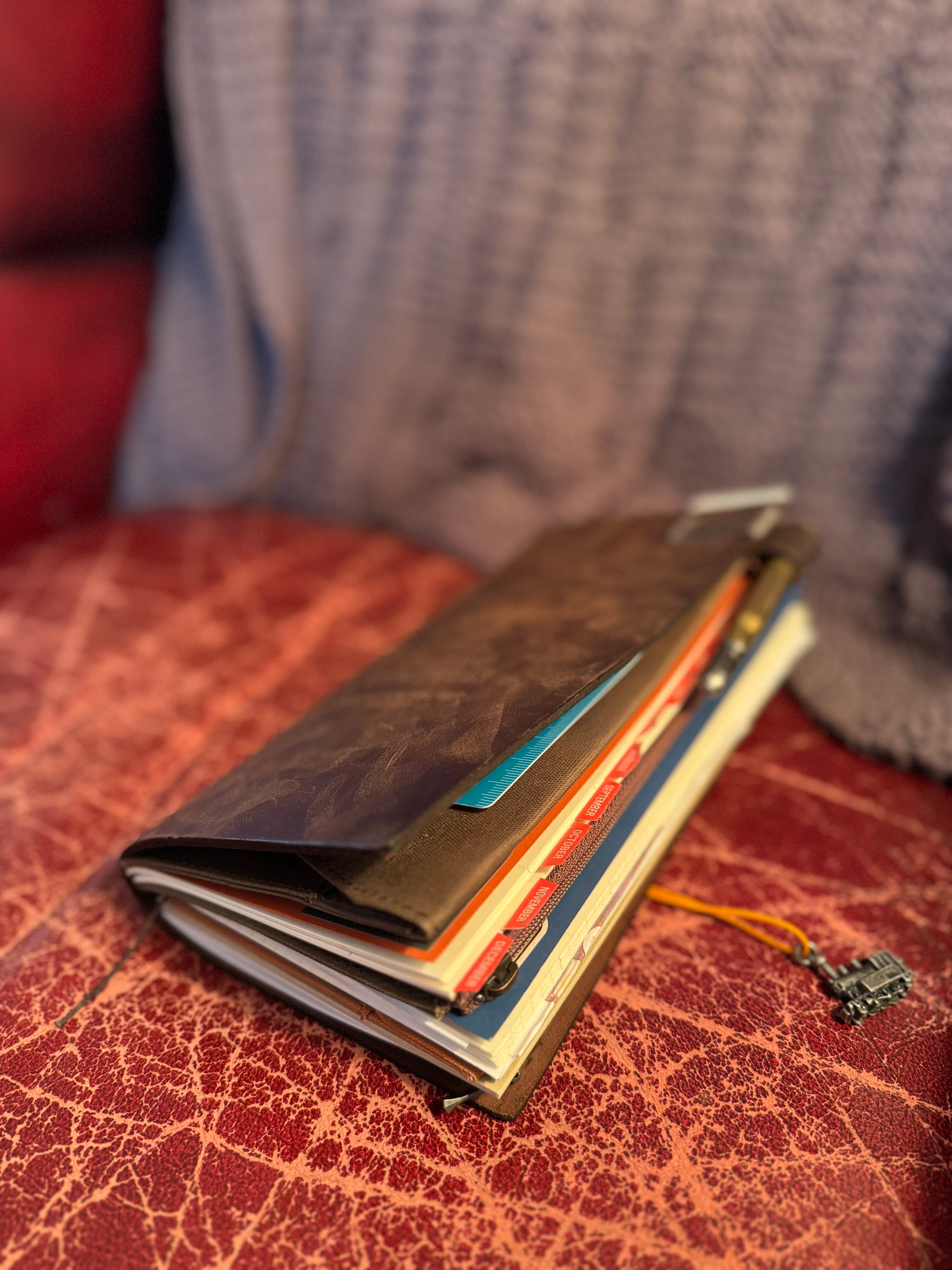
Here too: the invisible turning into something I can see and hear. That thought unfurls gently, like smoke, and my mind wanders to the notebooks I have kept and am keeping. There is a trunk in my house, an old thing of leather and brass, where finished notebooks sleep, their spines like folded pages of life. And there are the new ones I bind by hand now, still raw with glue and hope. They are, all of them, strange little altars to the passage of time. Paper accepts what we cannot always hold: half-remembered dreams, the sudden tenderness one feels at a bus stop, lists that read like prayers.
Notebooks are a medium for transfiguration. A planner tries to wrangle the day — a careful attempt to carve Chronos into something polite and manageable. A stream-of-consciousness page allows the subconscious to leak its light and shadow without permission. Notes taken on a walk catch the crispness of air and the small inventions of passing moments. A pasted photograph becomes a promise, a witness that the moment existed. Each act is an attempt to make the invisible tangible, to turn the mist of thought into something I can place in my two hands and press closed like a talisman.
That is why I am, perhaps absurdly, besotted with them. Notebooks feel like bridges. They connect what slips away — a melody half-remembered, a sorrow I cannot name, an ordinary kindness — to a firmness I can visit again. When I share them, when I gift a bound set of blank pages, I am offering a doorway. I want those who open them to feel the small shock of recognition: that wonder, that ache, that soft, dreaming attention which makes ordinary hours luminous.
Each notebook presents possibility. A stationery shop, to me, is a kind of Mecca: a hush of potential, shelves of waiting paper that quiver with the question of what will be born there. The first page of a new book is like that hour between dog and wolf — an unclaimed margin, both fragile and ferocious. To set pen to it is to risk becoming known to yourself.
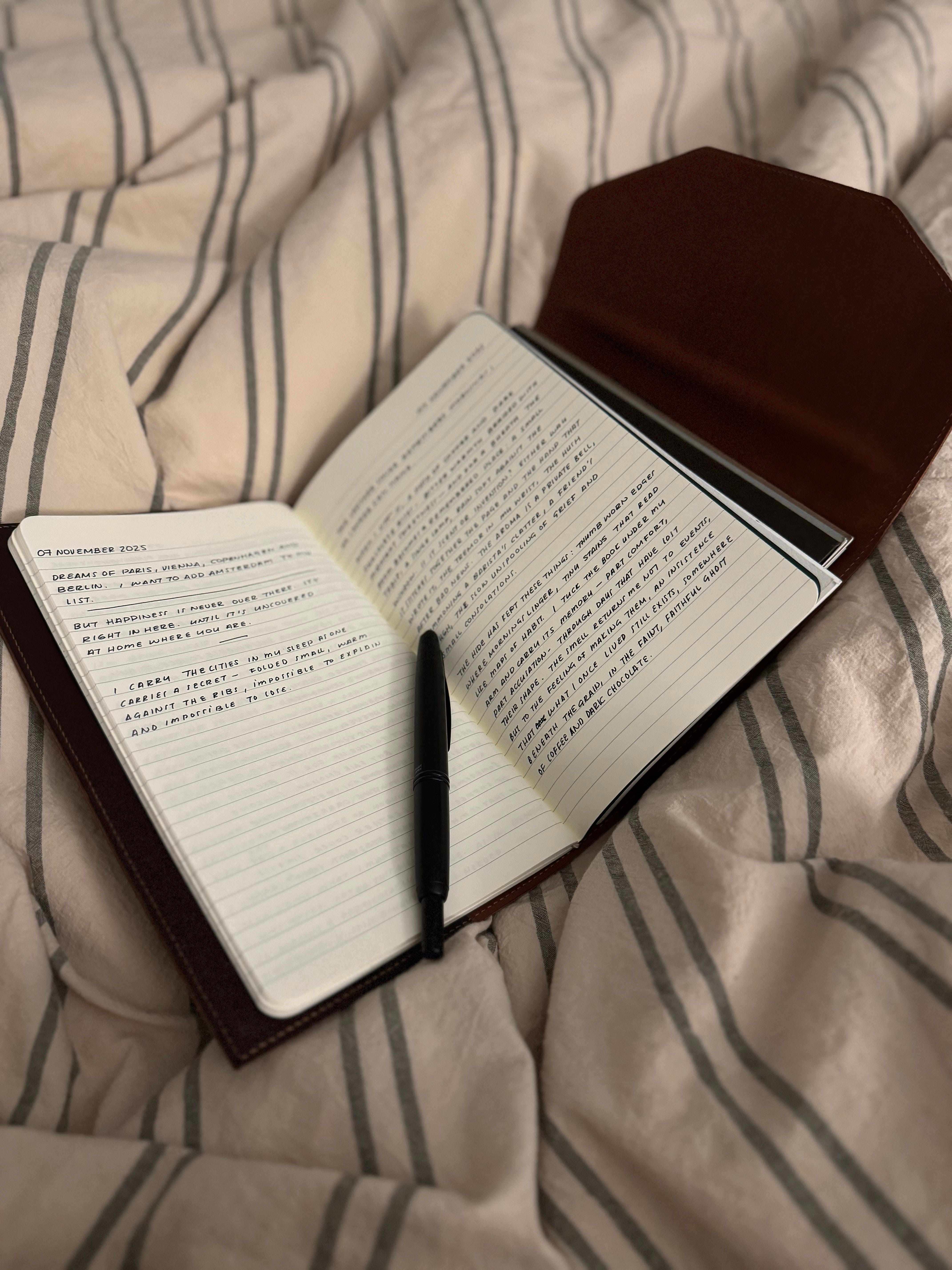
As autumn yields to winter and our internal clocks slow their relentless cadence, there is a peculiar generosity in slowing down enough to look. We might scold ourselves for indulgence, for lingering in the half-light, but the half-light keeps its own counsel. It is where small discoveries live: the way a sentence can change the shape of a day; the way a pasted photograph can reopen a throat once closed by grief; the way a list can become a map to what we love.
We could, if we wished, pretend a notebook is nothing more than a stack of paper. Or we can see it as something a little more — a witness in which metaphorical moisture gathers until, shyly, it beads into a droplet. That droplet might be a line of a poem, a plan that becomes a life, a memory preserved against future weather. If you have ever kept a book of such droplets, you will know how strange and consoling it is to hold a private weather in your hands.
So as the evenings lengthen and the wolfish dusk returns, consider taking a notebook with you. Let it be a small lamp for the kairotic hours. Write the things the light allows you to see: not only what happened, but what arrived uninvited — the hush, the unease, the glimmer. Keep them together; bind them, if you like, with a little ceremony. In the trunk or on a shelf they will wait. In years to come they will open like doors to rooms you had forgotten you once lived in.
There is a melancholy in all of this, yes — an ache like a piece of music that ends on a suspended chord. But there is also a dreaminess that makes melancholy soft around the edges, like dusk itself. The notebook is both witness and companion for that mood. It asks nothing grandly of us; it simply offers a place where the invisible can become, finally and tenderly, something we can hold.
So beautiful!